Why Running Shoes New Balance Still Dominate the Market
Running shoes New Balance are among the most trusted options for runners and active professionals alike. Whether you need a daily trainer, a race-day rocket, or something in between, New Balance has a model built for it.
Here are the top New Balance running shoes by use case:
| Use Case | Top Model | Audience Score |
|---|---|---|
| Racing / Competition | FuelCell SuperComp Elite v5 | 90 (Superb) |
| Speed / Tempo runs | FuelCell Rebel v5 | 90 (Superb) |
| Daily training | Fresh Foam X 1080 v14 | 87 (Great) |
| Trail running | Fresh Foam X Hierro v9 | 84 (Great) |
| Maximum cushioning | Fresh Foam X Balos | 90 (Superb) |
New Balance has spent decades earning the loyalty of serious runners. Their lineup covers everything from featherlight carbon-plated racers to plush daily trainers built to protect your joints mile after mile. With lab-tested energy return rates between 49% and 78%, stack heights up to 43mm, and models weighing as little as 198g, the brand backs its reputation with real performance data.
But it's not just about specs. Long-term runners consistently point to New Balance as a brand that keeps them on the road and out of the physio's office. That balance of performance and protection is exactly what makes this brand worth understanding in depth.
I'm Faisal S. Chughtai, a footwear expert who has spent years researching and reviewing running shoes new balance models to help active people find the right fit for their lifestyle and performance goals. My deep focus on comfort, support, and real-world performance means you'll get practical, no-fluff guidance throughout this guide.
The Science of Speed: Do Running Shoes New Balance Actually Make You Faster?
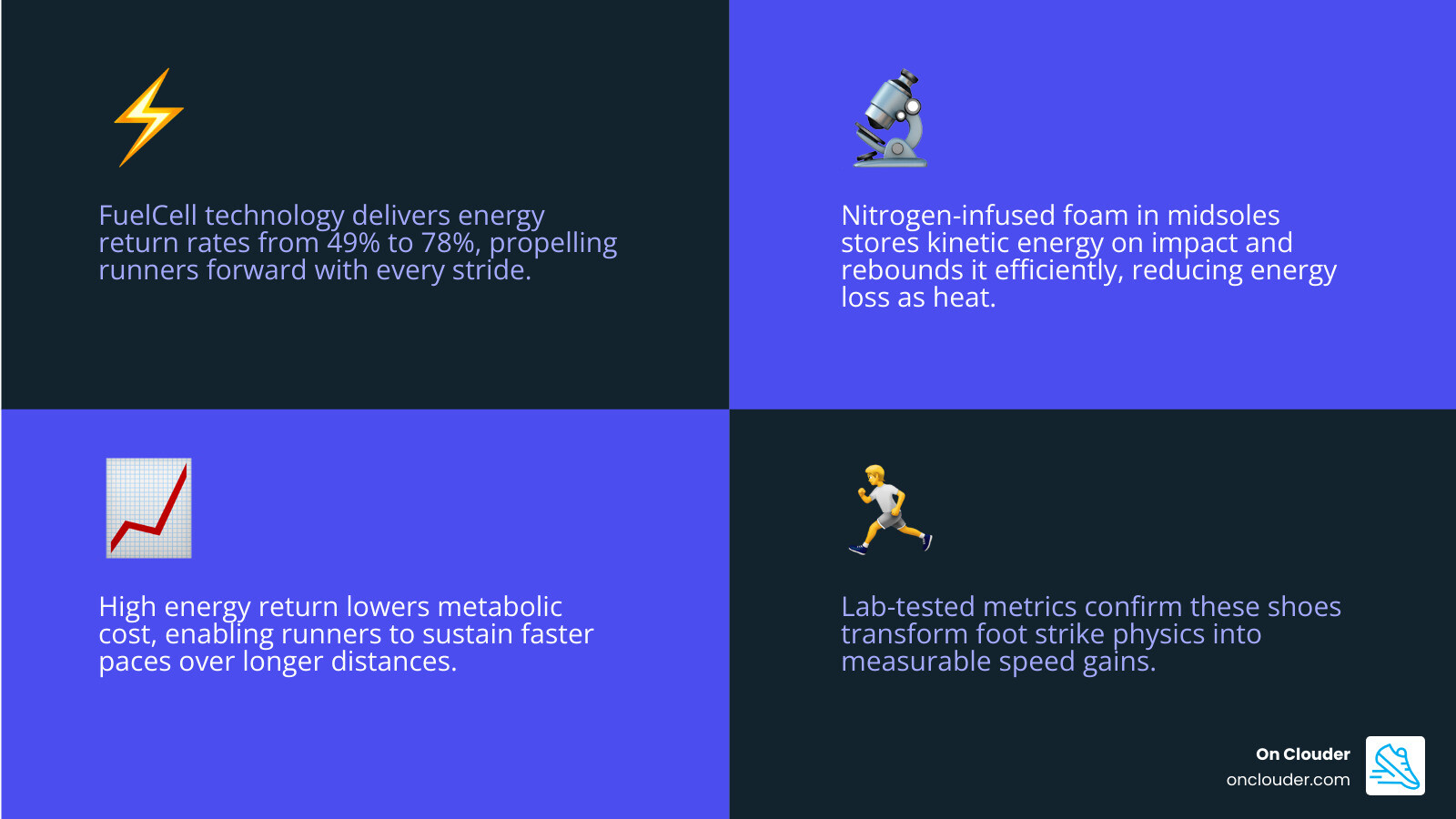
When we talk about speed in the modern era of running, we are really talking about physics and chemistry. The question of whether running shoes New Balance can actually improve your pace isn't just marketing fluff—it’s backed by lab-tested metrics. The secret sauce lies primarily in their FuelCell technology, a nitrogen-infused foam designed to provide a high degree of rebound.
In lab environments, New Balance shoes have shown energy return rates ranging from 49% to 78%. To put that in perspective, every time your foot strikes the pavement, the midsole compresses, storing kinetic energy. A high energy return means more of that energy is "pushed" back into your stride rather than being lost as heat. This reduces the metabolic cost of running, allowing you to maintain a faster pace for longer.
For those looking to shave seconds off a personal best, the Men's Running & Athletic Shoes category features models with integrated carbon plates and aggressive rocker geometry. These plates act as a lever, snapping the foot forward during the toe-off phase. Combined with stack heights that reach up to 43mm in the heel, these shoes provide a "trampoline effect" that is scientifically proven to enhance running economy.
However, speed isn't just about the "super shoes." Even in daily trainers, New Balance utilizes rocker shapes that encourage a smoother transition from heel to toe. While some runners ask Are On Clouds better than New Balance?, the answer often comes down to how much "pop" you want from your foam. New Balance tends to lean into a softer, more resilient feel that many find superior for maintaining efficiency over long distances.
Fresh Foam X vs. FuelCell: Choosing Your Performance Tech
One of the most common questions we get at On Clouder is how to choose between the two main New Balance foam technologies. Think of it like choosing between a luxury SUV and a turbocharged sports car.
Fresh Foam X is the brand's premiere EVA-based cushioning. It is designed for comfort, stability, and impact protection. It’s the "bread and butter" of the New Balance lineup, found in workhorse models like the W880v15. If your goal is to log 30 miles a week without your knees feeling like they’ve been through a meat grinder, Fresh Foam X is your best friend. In lab tests, these foams show softness ratings between 21 and 47 AC, indicating a plush yet supportive ride.
On the other hand, FuelCell is built for the "need for speed." It’s lighter and significantly more energetic. Models like the FuelCell Rebel v5 are favorites for tempo runs because they feel "bouncy." When comparing On Cloud vs New Balance 880, you’ll notice that New Balance’s Fresh Foam offers a more consistent, dampened landing, whereas FuelCell is all about the launch.
Top-Rated Running Shoes New Balance for Racing and Speedwork
If you have a race on the calendar, you aren't looking for "comfortable enough"—you’re looking for a competitive edge. The FuelCell SuperComp Elite v5 is the current pinnacle of New Balance racing. With an audience score of 90 (Superb), it’s a heavyweight in performance but a featherweight on the scale.
For women looking for elite performance, the Women's Running Shoes section offers the same high-tier tech tailored for different foot shapes. When we look at Saucony vs New Balance, New Balance often wins out for runners who want a slightly more stable platform even in their "super shoes."
Top Speed Models:
- SuperComp Elite v5: The marathon racer. Carbon-plated and max-stack.
- FuelCell Rebel v5: The "speed trainer." No plate, but incredibly light and responsive for intervals.
- SC Pacer: A lower-profile plated shoe for 5K and 10K distances.
Daily Trainers and Injury Prevention in Running Shoes New Balance
While speed gets the headlines, most of us spend 90% of our time in daily trainers. This is where New Balance truly shines in terms of longevity and injury prevention. The Fresh Foam X 1080 is arguably the most famous neutral trainer in the world, known for its versatility.
For those who struggle with overpronation (feet rolling inward), the M860v14 provides a dual-density post or stability plane to keep the foot neutral. This is a critical feature for preventing common issues like plantar fasciitis or shin splints. When comparing Hoka vs New Balance, New Balance is often cited for having a more "natural" stability feel rather than the aggressive "bucket seat" feel of some competitors.
Finding the Perfect Fit: Biomechanics and Width Options
One of the primary reasons New Balance is the "GOAT" (Greatest of All Time) for many runners is their commitment to fit. While many brands offer a "one size fits most" approach, New Balance is one of the few that consistently manufactures their top performance models in multiple widths.
If you have a wide foot, you know the struggle of feeling like your pinky toe is trying to escape through the mesh. New Balance offers 2E (Wide) and 4E (Extra Wide) options in many of their flagship shoes. Check out our guide on New Balance 2E vs 4E to see which one matches your foot shape.
Beyond width, you need to consider heel-to-toe drop. New Balance offers a massive range here, from a "natural" 2mm drop to a more traditional 15mm drop. A higher drop (like in the 880 series) is often better for those with Achilles tendon issues, while a lower drop (like the Fresh Foam X More v6) can help shift the load to the glutes and hamstrings.
Key Fit Metrics to Watch:
- Toebox Width: Usually ranges from 69mm to 79mm.
- Arch Support: Models like the Vongo or 860 are better for flat feet, while the 1080 is a "neutral" dream.
- Customization: New Balance shoes are famously "orthotic friendly," meaning the factory insoles are easy to swap for custom versions.
Frequently Asked Questions about New Balance Performance
Are New Balance shoes better for training or racing?
The answer is both, but they serve different masters. For training, New Balance is legendary for durability. Many users report getting 400-500 miles out of a pair of 880s or 1080s. The outsoles use high-abrasion rubber that wears down at a rate of only 0.2mm to 1.4mm over hundreds of miles.
For racing, the Running Shoes & Sneakers category has evolved. Historically, NB was seen as a "heavy" training brand, but the FuelCell revolution changed that. Today, their racing models are as light and efficient as any on the market, though they still tend to offer a slightly wider, more stable base than some of the "knife-edge" racers from other brands.
How long do New Balance running shoes last?
On average, you can expect 300 to 500 miles from a pair of high-quality running shoes New Balance. However, this depends on your gait and where you run. If you are using them as a crossover shoe, you might want to read our comparison on On Cloud vs New Balance for walking to see how the foam holds up under different types of pressure.
Signs it's time to replace your NBs:
- The midsole feels "dead" or flat (compressed foam).
- The tread on the outsole has worn smooth in high-impact areas.
- You start feeling new aches in your knees or hips after a run.
Which model is best for high arches?
For runners with high arches (supinators), you need "neutral" cushioning that allows the foot to move through its natural cycle while absorbing maximum shock. The Fresh Foam X Balos and the 1080 v14 are the gold standards here. They provide plenty of "squish" to compensate for the lack of natural shock absorption in a high-arched foot. We’ve done a deep dive on this in our On Cloudmonster vs New Balance 1080 comparison, which highlights how the 1080’s Fresh Foam X is particularly effective for underpronators.
Conclusion
At On Clouder, our expert verdict is clear: New Balance remains a "GOAT" because they refuse to sacrifice fit for fashion. While they have some of the most technologically advanced "super shoes" on the market, they haven't forgotten the daily runner who just wants a shoe that fits well and lasts a long time.
Whether you are chasing a sub-3-hour marathon in the FuelCell SuperComp Elite or just trying to stay active and injury-free in the Fresh Foam X 1080, New Balance provides the data-backed performance you need.
Ready to compare these to other top brands? Check out our On Cloud Shoes: A Step-by-Step Guide to see how the latest innovations stack up against the classic reliability of New Balance.
