Why New Balance Running Shoes Are Still the GOAT


Why Running Shoes New Balance Still Dominate the Market


Running shoes New Balance are among the most trusted options for runners and active professionals alike. Whether you need a daily trainer, a race-day rocket, or something in between, New Balance has a model built for it.

Here are the top New Balance running shoes by use case:

Use Case Top Model Audience Score
Racing / Competition FuelCell SuperComp Elite v5 90 (Superb)
Speed / Tempo runs FuelCell Rebel v5 90 (Superb)
Daily training Fresh Foam X 1080 v14 87 (Great)
Trail running Fresh Foam X Hierro v9 84 (Great)
Maximum cushioning Fresh Foam X Balos 90 (Superb)

New Balance has spent decades earning the loyalty of serious runners. Their lineup covers everything from featherlight carbon-plated racers to plush daily trainers built to protect your joints mile after mile. With lab-tested energy return rates between 49% and 78%, stack heights up to 43mm, and models weighing as little as 198g, the brand backs its reputation with real performance data.

But it's not just about specs. Long-term runners consistently point to New Balance as a brand that keeps them on the road and out of the physio's office. That balance of performance and protection is exactly what makes this brand worth understanding in depth.

I'm Faisal S. Chughtai, a footwear expert who has spent years researching and reviewing running shoes new balance models to help active people find the right fit for their lifestyle and performance goals. My deep focus on comfort, support, and real-world performance means you'll get practical, no-fluff guidance throughout this guide.
Evolution of New Balance cushioning technology from Fresh Foam to FuelCell across key models - running shoes new balance

The Science of Speed: Do Running Shoes New Balance Actually Make You Faster?

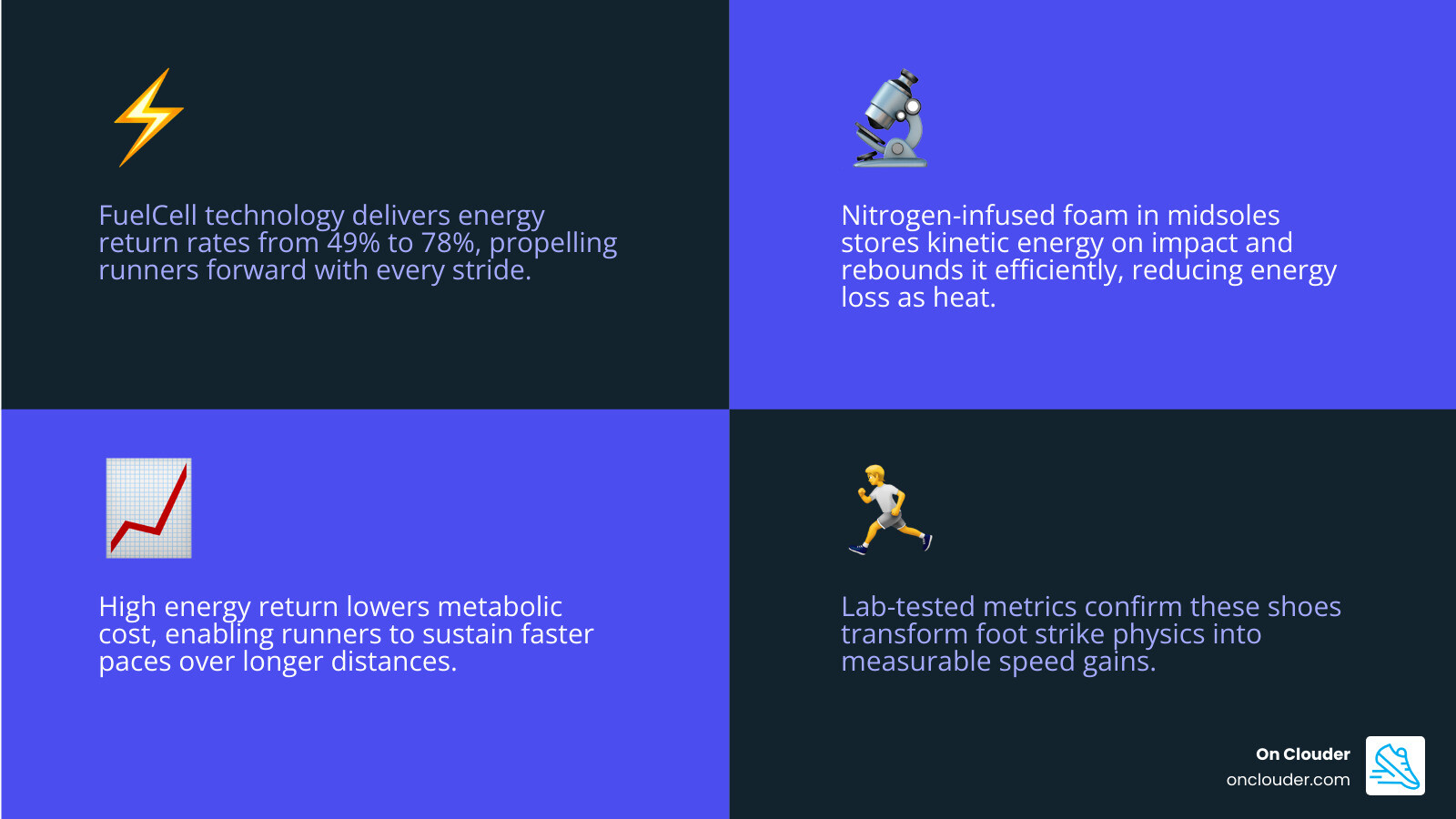
When we talk about speed in the modern era of running, we are really talking about physics and chemistry. The question of whether running shoes New Balance can actually improve your pace isn't just marketing fluff—it’s backed by lab-tested metrics. The secret sauce lies primarily in their FuelCell technology, a nitrogen-infused foam designed to provide a high degree of rebound.

In lab environments, New Balance shoes have shown energy return rates ranging from 49% to 78%. To put that in perspective, every time your foot strikes the pavement, the midsole compresses, storing kinetic energy. A high energy return means more of that energy is "pushed" back into your stride rather than being lost as heat. This reduces the metabolic cost of running, allowing you to maintain a faster pace for longer.

For those looking to shave seconds off a personal best, the Men's Running & Athletic Shoes category features models with integrated carbon plates and aggressive rocker geometry. These plates act as a lever, snapping the foot forward during the toe-off phase. Combined with stack heights that reach up to 43mm in the heel, these shoes provide a "trampoline effect" that is scientifically proven to enhance running economy.

However, speed isn't just about the "super shoes." Even in daily trainers, New Balance utilizes rocker shapes that encourage a smoother transition from heel to toe. While some runners ask Are On Clouds better than New Balance?, the answer often comes down to how much "pop" you want from your foam. New Balance tends to lean into a softer, more resilient feel that many find superior for maintaining efficiency over long distances.

Fresh Foam X vs. FuelCell: Choosing Your Performance Tech

One of the most common questions we get at On Clouder is how to choose between the two main New Balance foam technologies. Think of it like choosing between a luxury SUV and a turbocharged sports car.

Fresh Foam X is the brand's premiere EVA-based cushioning. It is designed for comfort, stability, and impact protection. It’s the "bread and butter" of the New Balance lineup, found in workhorse models like the W880v15. If your goal is to log 30 miles a week without your knees feeling like they’ve been through a meat grinder, Fresh Foam X is your best friend. In lab tests, these foams show softness ratings between 21 and 47 AC, indicating a plush yet supportive ride.

On the other hand, FuelCell is built for the "need for speed." It’s lighter and significantly more energetic. Models like the FuelCell Rebel v5 are favorites for tempo runs because they feel "bouncy." When comparing On Cloud vs New Balance 880, you’ll notice that New Balance’s Fresh Foam offers a more consistent, dampened landing, whereas FuelCell is all about the launch.

Top-Rated Running Shoes New Balance for Racing and Speedwork

If you have a race on the calendar, you aren't looking for "comfortable enough"—you’re looking for a competitive edge. The FuelCell SuperComp Elite v5 is the current pinnacle of New Balance racing. With an audience score of 90 (Superb), it’s a heavyweight in performance but a featherweight on the scale.

For women looking for elite performance, the Women's Running Shoes section offers the same high-tier tech tailored for different foot shapes. When we look at Saucony vs New Balance, New Balance often wins out for runners who want a slightly more stable platform even in their "super shoes."

Top Speed Models:

  • SuperComp Elite v5: The marathon racer. Carbon-plated and max-stack.
  • FuelCell Rebel v5: The "speed trainer." No plate, but incredibly light and responsive for intervals.
  • SC Pacer: A lower-profile plated shoe for 5K and 10K distances.

Daily Trainers and Injury Prevention in Running Shoes New Balance

While speed gets the headlines, most of us spend 90% of our time in daily trainers. This is where New Balance truly shines in terms of longevity and injury prevention. The Fresh Foam X 1080 is arguably the most famous neutral trainer in the world, known for its versatility.

For those who struggle with overpronation (feet rolling inward), the M860v14 provides a dual-density post or stability plane to keep the foot neutral. This is a critical feature for preventing common issues like plantar fasciitis or shin splints. When comparing Hoka vs New Balance, New Balance is often cited for having a more "natural" stability feel rather than the aggressive "bucket seat" feel of some competitors.

Finding the Perfect Fit: Biomechanics and Width Options

One of the primary reasons New Balance is the "GOAT" (Greatest of All Time) for many runners is their commitment to fit. While many brands offer a "one size fits most" approach, New Balance is one of the few that consistently manufactures their top performance models in multiple widths.

If you have a wide foot, you know the struggle of feeling like your pinky toe is trying to escape through the mesh. New Balance offers 2E (Wide) and 4E (Extra Wide) options in many of their flagship shoes. Check out our guide on New Balance 2E vs 4E to see which one matches your foot shape.

Beyond width, you need to consider heel-to-toe drop. New Balance offers a massive range here, from a "natural" 2mm drop to a more traditional 15mm drop. A higher drop (like in the 880 series) is often better for those with Achilles tendon issues, while a lower drop (like the Fresh Foam X More v6) can help shift the load to the glutes and hamstrings.

Key Fit Metrics to Watch:

  • Toebox Width: Usually ranges from 69mm to 79mm.
  • Arch Support: Models like the Vongo or 860 are better for flat feet, while the 1080 is a "neutral" dream.
  • Customization: New Balance shoes are famously "orthotic friendly," meaning the factory insoles are easy to swap for custom versions.

Frequently Asked Questions about New Balance Performance

Are New Balance shoes better for training or racing?

The answer is both, but they serve different masters. For training, New Balance is legendary for durability. Many users report getting 400-500 miles out of a pair of 880s or 1080s. The outsoles use high-abrasion rubber that wears down at a rate of only 0.2mm to 1.4mm over hundreds of miles.

For racing, the Running Shoes & Sneakers category has evolved. Historically, NB was seen as a "heavy" training brand, but the FuelCell revolution changed that. Today, their racing models are as light and efficient as any on the market, though they still tend to offer a slightly wider, more stable base than some of the "knife-edge" racers from other brands.

How long do New Balance running shoes last?

On average, you can expect 300 to 500 miles from a pair of high-quality running shoes New Balance. However, this depends on your gait and where you run. If you are using them as a crossover shoe, you might want to read our comparison on On Cloud vs New Balance for walking to see how the foam holds up under different types of pressure.

Signs it's time to replace your NBs:

  1. The midsole feels "dead" or flat (compressed foam).
  2. The tread on the outsole has worn smooth in high-impact areas.
  3. You start feeling new aches in your knees or hips after a run.

Which model is best for high arches?

For runners with high arches (supinators), you need "neutral" cushioning that allows the foot to move through its natural cycle while absorbing maximum shock. The Fresh Foam X Balos and the 1080 v14 are the gold standards here. They provide plenty of "squish" to compensate for the lack of natural shock absorption in a high-arched foot. We’ve done a deep dive on this in our On Cloudmonster vs New Balance 1080 comparison, which highlights how the 1080’s Fresh Foam X is particularly effective for underpronators.

Conclusion

At On Clouder, our expert verdict is clear: New Balance remains a "GOAT" because they refuse to sacrifice fit for fashion. While they have some of the most technologically advanced "super shoes" on the market, they haven't forgotten the daily runner who just wants a shoe that fits well and lasts a long time.

Whether you are chasing a sub-3-hour marathon in the FuelCell SuperComp Elite or just trying to stay active and injury-free in the Fresh Foam X 1080, New Balance provides the data-backed performance you need.

Ready to compare these to other top brands? Check out our On Cloud Shoes: A Step-by-Step Guide to see how the latest innovations stack up against the classic reliability of New Balance.

Officials urge businesses towards localisation


 KARACHI:

Government high officials have urged the Pakistani business community to start working on import substitution, the localisation of imported products and to promote exports in order to become competitive in the global economy.

Localisation means producing required products and parts locally instead of continuing to rely on imports. This would also mean replacing imported energy with renewable energy like hydroelectricity to contain the cost of energy - currently standing at one-third of the overall import bill.

Speaking at a one-day conference on the ‘National Policy Dialogue on Localisation for Growth’ organised by Nutshell Group and K-Electric (KE), Minister of State Malik Musadik said, “We can only become competitive on a global scale if we achieve a local edge. When we talk about localisation, we must develop clusters, where several economic activities are taking place in one geographic area.”

According to a press statement, he said “Soon, we aim to bring down UFGs (unaccounted for gas/ line losses of gas) and the circular debt to zero, but that doesn’t mean all our problems will vanish. We still have a long way to go. Above all, we need to build a level playing field where competition is on productivity and innovation alone.”

Federal Minister for Power, Khurram Dastagir said “Electric vehicles’ initiatives will cut emissions in half and imported fuel consumption by half; just this will save us dollars and provide expanded opportunities for employment and infrastructural development in Pakistan.”

“Pakistan is 75 years old, and we have had so many talks but no solutions. To achieve progress, we have to identify the problems and then work together to fix them instead of working to fix each other. Localisation begins with everyone coming together under one common identity. I agree that the State is responsible for the direction, but so is the nation. Leaders are unsure and the nation is divided,” said Kamran Tessori, Governor Sindh.

K-Electric CEO, Syed Moonis Abdullah Alvi also shared some impressive numbers about the investments being made by the company to increase its customer-base, reduce the percentage of power outages, and, most importantly, increase the contribution of renewable resources to generate power. KE has invested Rs474 billion across the value chain, and soon (by 2030) the company will be generating 2172 MW of renewable energy.

“Our conviction is to base our generation on indigenous fuels and lower our reliance on imported fuels. Our ambition is to invest Rs484 billion in the value chain over the next seven years. When we have this predictability and projected demand of equipment, we believe it is best to buy locally and encourage domestic growth. The predictability of policies will support this vision, and collectively reduce pressure on the national exchequer. I request we collaborate and produce avenues for local resources,” said Alvi, CEO.

Banks lent 83% deposits to govt in Feb


KARACHI:

The State Bank of Pakistan (SBP), on Monday, reported that bank deposits grew 15% in one-year to Rs22.92 trillion in February, compared to Rs19.91 trillion in the same month of last year.

The financial institutions utilised a large portion of the deposits in lending to the government, causing a sluggish growth in credit to the private sector amid an economic slowdown.

Arif Habib Limited (AHL) Economist Sana Tawfik was quoted as saying, “Financial experts said the growth in deposit has been recorded mainly due to notable inflows of workers’ remittances, a jump in government borrowing, as well as a considerable slowdown in economic activities. Each of these factors led to the corporate sector depositing their funds instead of investing them in projects in wait for a return to normalcy.”

Pakistan has received $18 billion (over Rs5 trillion at an exchange rate of Rs280/$) in workers’ remittances in the first eight months (Jul-Feb) of the current fiscal year 2023.

Foreign inflows are normally received in Pakistani rupees by family members expatriates, who utilise the funds to mostly meet day-to-day expenses, leave in banks, or invest in different assets; mostly real estate.

Economist Shahid Hasan Siddiqui said the government has continued to borrow heavily from commercial banks.

“Massive government borrowing has multiplied money growth in the system and caused a jump in deposits at banks,” said an analyst.

The economic slowdown has forced the corporate sector to put new investment projects on hold, in wait for the return of stability in economic activities. Banks, however, have mostly utilised the deposits in safe lending to the government, instead of extending deposits to the private sector to support business activities in the country.

The government is borrowing funds to finance mostly non-development projects, and to fulfil its budgeted expenditures like paying interest money or to finance monthly pay and pension.

On the contrary, lending to the private sector always pays back to the society, as the sector utilises the funds to set up new projects and creates job opportunities.

Bankers themselves have criticised the imbalanced institutional lending, urging financial institutions to play their due role in growing the economy.

Banks’ lending to the government (through investment in T-bills and Pakistan Investment Bonds (PIBs)) has spiked 31% in the last one-year, to almost Rs19 trillion in February, compared to Rs14.54 trillion in the same month of the last year.

Accordingly, banks have cumulatively lent almost 83% of the total deposits to the government as in February 2023, meaning banks’ investment to deposit ratio (IDA) stands at 83%.

On the contrary, banks’ have advanced 51% of the total deposits to the private sector; meaning the advance to deposit ratio (ADR) stands at 51% as in February 2023.

Central bank data suggests the investment to deposit ratio (IDA) grew by a notable 10% in the past one year till February 28, 2023. On the contrary, ADR improved just 1% in the past year until February 2023.

Financial experts said bankers have asked financial institutions to increase lending to the private sector, including the small and medium-sized enterprise (SMEs) sector, to help the economy grow.

Rupee stabilises

The volatile Pakistani rupee is stabilising at around Rs280 against the US dollar in the interbank market, as it has continued to move around the level for the past few days.

It dropped 0.30%, or Rs0.84, to close at Rs281.61 against the greenback on Monday, according to the central bank, recovering by 0.54% to close at Rs280.77/$ on Friday.

The latest depreciation in the rupee, however, is seen amid reports about a few days delay in the revival of the International Monetary Fund (IMF) loan programme for Pakistan.

Published in The Express Tribune, March 14th, 2023. 

Government plods towards IMF deal


 ISLAMABAD:

Pakistan has managed to convince the International Monetary Fund (IMF) to reduce external additional loan requirement to $6 billion amid government’s desire to give Rs150 billion subsidised petrol package to motorcyclists.

In order to avoid an objection by the IMF, roughly Rs150 billion annual subsidy on account of Rs25 to Rs50 per litre is planned to be recovered from car owners, according to discussions that took place at the Prime Minister’s House on Monday.

“The proposal is to raise the petrol price in the range of Rs300 to Rs325 per litre for car owners but reduce it to Rs250 to Rs225 per litre for motorcyclists,” according to sources.

Prime Minister Shehbaz Sharif is throwing a new challenge to the economic team at a time when the finance ministry and the State Bank of Pakistan (SBP) are already grappling with the issues of arranging $6 billion more loans and a further hike in the interest rates.

A high-ranking government functionary told The Express Tribune that the IMF and Pakistan last week found a middle ground on the issue of external financing gap. “Against the IMF’s earlier estimates of $7 billion external financing gap, both sides have now agreed to reduce the estimates to $6 billion,” he added.

The $1 billion reduction in financing needs means, lowering the new loan requirement by the same amount.

While addressing a news conference last week, Finance Minister Ishaq Dar said that he had valid reasons to believe that the external financing gap was not $7 billion but $5 billion.

“The reduction has been achieved by marginally reducing the projection of the current account deficit and lowering the foreign exchange building requirements,” he added. The current account deficit is now being projected around $7.7 billion -- as against the earlier IMF projection of $8.2 billion, he added.

Another roughly $500 million is being reduced against the projected foreign exchange reserves requirement for the current fiscal year. “The IMF is now willing to consider the foreign exchange reserves level equal to 1.7 months of prospective imports cover,” according to the senior government functionary.

Pakistan’s gross official foreign exchange reserves stand at $4.3 billion -- not enough for one month of import cover.

However, despite shaving off $1 billion from the estimates, Pakistan’s woes have not ended. It still has to arrange assurances from the regional countries for $6 billion additional loans.

Pakistan has claimed that it has so far $2 billion assurance from Saudi Arabia and $1 billion from the United Arab Emirates (UAE), leaving it with a gap of $3 billion.

The sources said that Finance Minister Ishaq Dar made a telephonic call on Monday to the finance minister of Qatar to get his country’s help bridging the financing gap.

The IMF is reluctant to announce a staff-level agreement until it is sure that the regional countries will bailout Pakistan.

In August last year, the directors of the regional countries China, Qatar, Saudi Arabia and the UAE, had given assurances at the IMF board that they would provide additional financing of $4 billion. But this did not materialise.

The finance ministry has a desire that the IMF should take the country’ case for board approval on March 24th – a date that seems overambitious given the fact both sides have not reached a staff-level agreement.

So far, Pakistan has increased the electricity prices, gas prices, fuel prices, devalued the currency and increased the interest rates by 3% to record high level of 20%.

The sources said that the issue of interest rate hike was not completely settled yet and another interest rate hike might be on the horizon. The central bank has already convened a meeting of the Monetary Policy Committee on April 4th.

After the recent hike, the real interest rate was slightly positive compared to the core inflation. But the IMF calculated the inflation adjusted positive interest rate from the headline inflation rate. Dr Reza Baqir-led central bank had agreed to link the rate with the headline inflation. The headline inflation in February hit a 50-year high of 31.5%.

At the beginning of the IMF programme in 2019, the policy rate stood at 10.75%, which have almost doubled. SBP Governor Jameel Ahmad did not respond to a question by The Express Tribune whether “the IMF has asked Pakistan to further increase the interest rates”.

New challenge

According to press statement by the PM’s Office, Prime Minister Shehbaz chaired a meeting on pro-poor initiatives. The meeting was briefed about the provision of concessional petrol to motorcyclists and rickshaws, according to the statement. The prime minister instructed for finalising the package, it added.

The sources told The Express Tribune that discussion was held to cut the petrol price by Rs25 to Rs50 per litre for the motorcyclists. They added that the estimated cost of the provision of the subsidised fuel was Rs150 billion, which would be borne by the car owners.

Effectively the petrol will be cheaper by Rs50 to Rs100, depending upon the option, compared to the cost being paid by a car owner.

The final number was not locked but the per-litre cross subsidy could be Rs50 to Rs100 that would cost about Rs150 billion, according to another participant of the meeting.

The government officials said that the mechanism to provide the fuel had not been finalised but the options include provision of one-time password, giving pre-paid cards or giving cash.

The prime minister instructed that at least Rs1,000 per month petrol subsidy should be given to the motorcyclists by recovering from car owners, they added.

However, the government seems playing a gamble with the IMF and the voters, as neither the IMF may support such a proposal nor the consumers will pay higher prices to finance the government’s election campaign.

If the government goes ahead with its plan to increase the petrol prices for car owners, it might be challenged in the courts due to its discriminatory nature. A PTI supporter will not pay for the cost of the PML-N’s political venture.

The proposal to take Rs25 to Rs50 per litre from a car owner and give it to motorcyclist is a double-edged sword, according to another meeting participant. Former prime minister Imran Khan had also given Rs200 billion fuel subsidy in February 2022, which led to derailment of the IMF programme.

The prime minister also directed to give wheat flour subsidy to one million people of Islamabad that would cost Rs1 billion per annum. The premier on Monday also fixed the minimum cotton intervention price at Rs8,500 per 40kgs – up from Rs5,700.

ads